
I picked up drawing at the beginning of this year, and I drew more or less every day for about a hundred days. I’ve accumulated 90 loose leaf pages of drawing so far. Here are some of my reflections on it.
§ All creative practices involve inherently the same struggle
You might call it the struggle between “what you imagined you’d create” and “what you actually created.” When I first started drawing I wanted to get a break from writing because writing had become unpleasant in a way that was hard to describe.
At the very early stages the joy of drawing was very pure and refreshing. What I found over time though was that the same problems I had with writing would creep up in this new medium: perfectionism, frustration, impatience. It was a relief to experience this, because it helped me dispel the illusion that “I should stop writing” and instead recognize that “creative work in general is hard.”
There are also fundamental differences between drawing and writing that made drawing especially fun for me. It is a non-literal, non-analytical activity. It really grounds you in a way that writing doesn’t. It forces you to look more closely at the world around you. (FWIW: the best writing also does this, but it’s possible to do a lot of writing without getting this effect.)
§ There are no parallel lines in the world, and other illusions
There are a lot of little things you discover as you get into drawing about how your visual field actually works.
For example, a lot of lines that are parallel “in reality” are not actually parallel in your visual field. This is a very basic point about perspective that many people know, but it wasn’t until I started drawing a lot that I really began to see it everywhere. If you just look down a long hallway, it’s not immediately obvious that the far end of the hall is significantly smaller than the closer end. Your brain does a really good job of converting this “smallness” into a mental construct of “distance”, such that you no longer see its smallness at all, you just see it as “far away.”

There are so many other examples of this. A lot of “lines” that we see around us are actually just differently colored shadows falling on different sides of an object. There are far fewer actual lines in the world than it first appears. For example, in the pillars below, if you go right up to them you won’t actually see “lines” where the edges are; the appearance of all those vertical lines is just a byproduct of shadows. This is also very easy to see on window sills since they’re usually just one color but give you the impression of “sharp lines.”

§ We can see texture as much as we can feel it
As a novice you think drawing is fundamentally about geometry. And it sort of is, but texture is also a really big part. Texture is something that is essentially tactile but our eyes are really good at predicting what a texture will feel like just from the way it looks. And when you start looking closely at what different textures actually look like you get better at drawing them.
In the drawing lessons I’ve been doing, the instructor gives an example of how he used just a pen to evoke very different textures:
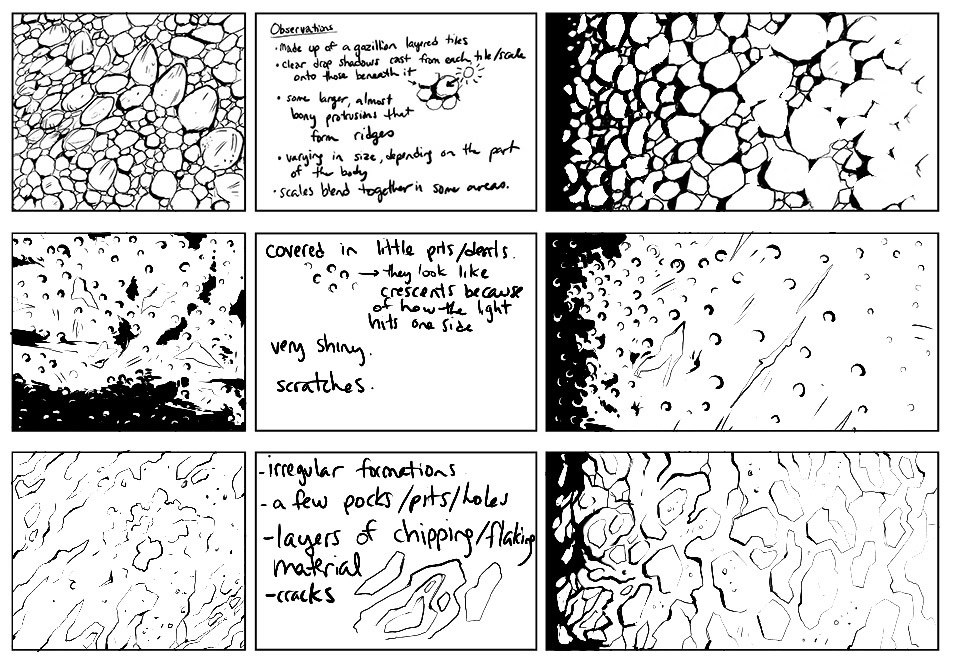
What I also found interesting is the instructor’s remark that all textures involve some mix of order and chaos. Just scribbling a bunch of random lines usually doesn’t give you the texture you’re trying to reproduce.
You may find a texture that feels like it’s just a bunch of nonsense, crazy chaotic marks. It’s not - it never is. There’s always some sort of rhythm to them, a flow that they follow because that’s how the physical world works.
Maybe what makes a drawing feel “real” is is that perfect interplay between chaos and order.
§ It feels so good to slowly get better at something
I often think about how Mark Zuckerberg learns a completely new hobby every year – jiu jitsu, learning Mandarin, et cetera. I can imagine this being really useful for cultivating a kind of youthful agility.
It is also hard to pick up new skills. But the great thing about all the online learning resources out there is that they give you the scaffolding such that it is always just hard enough that you’re learning something but still easy enough that it feels fun to do it. (Shoutout to Lev Vygotsky’s zone of proximal development).
§ Every field becomes more detailed and bigger upon closer inspection
There’s so many different kinds of drawing and disciplines in drawing, different tools, different schools of thought. Like, shading with a pencil is one kind of thing and shading with a pen is a whole different thing (it’s harder).
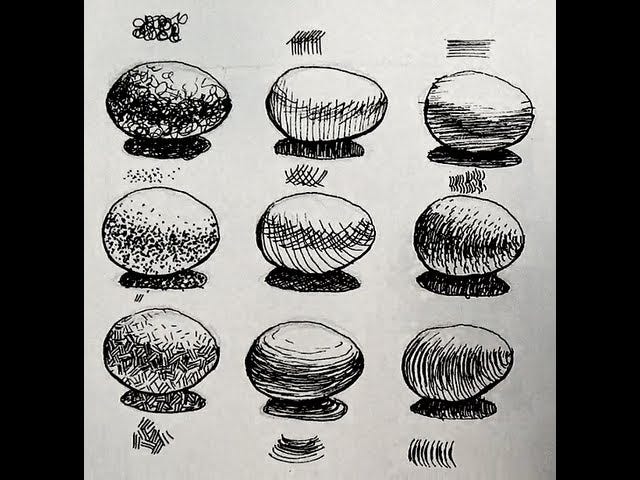
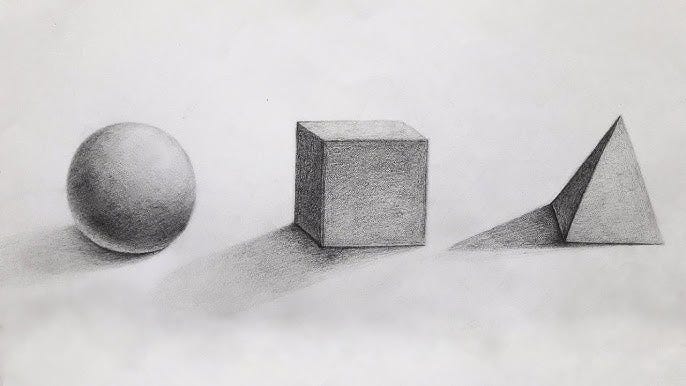
There are so many different kinds of drawing. There’s abstract drawing and more figurative work. You can take an entire course on inking or an entire course on observational drawing.
There is depth everywhere. A surprising amount of theory goes into simply drawing a box – you can draw it in one-point perspective, two-point perspective, or three-point perspective (or isometric if you don’t care about it looking realistic).
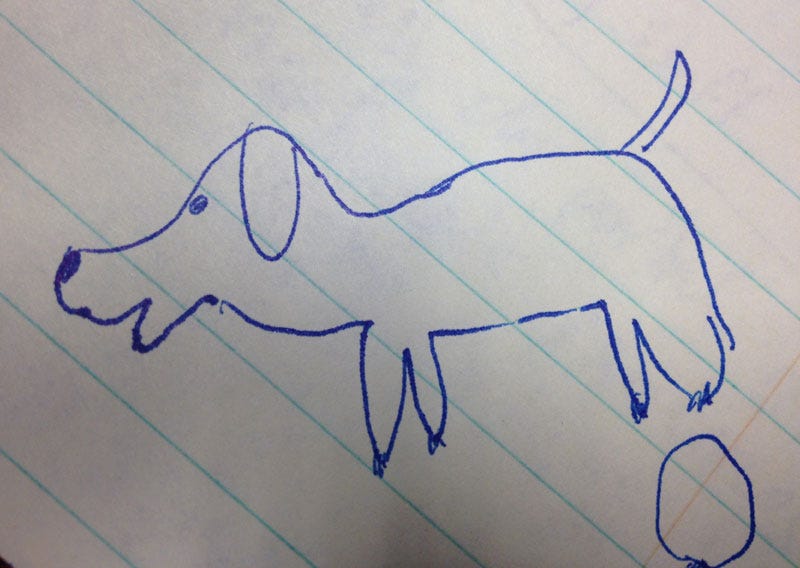
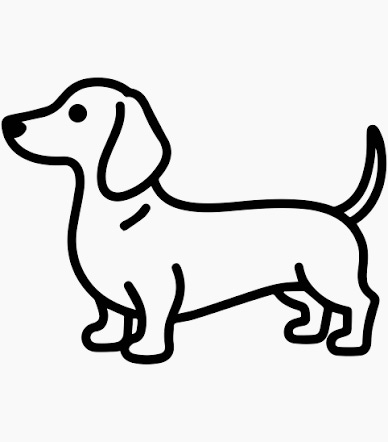
There is also subtlety to composition – the relative placement and size and occlusion of different objects in your scene is crucial for how realistic it looks. A good example is when drawing the legs of a dog – a beginner would draw both pairs of legs sort of flat, but with experience you realize you need the further legs to be partly occluded, partly higher up, and just a little bit smaller. Contrast the legs in the two drawings below:
§ How to start
I’ve mostly been following Drawabox which has a ton of free, very structured lessons and exercises (they’re almost too structured – don’t take the teacher’s prescriptions too seriously). Shoutout to my friends Song and Liam who have coached me a lot through this process.
I also like You Can Draw in 30 Days, although that one is in pencil (Drawabox teaches pen).
I’ve had Drawing on the Right Side of the Brain on my list for the longest time but haven’t read it yet; it seems to connect drawing to some of the Buddhist concepts I’m into: “the first thing you learn in painting class is emptiness…draw what you see, not what you know.”
You can learn a lot in just 15 minutes a day!
§ Proof of work
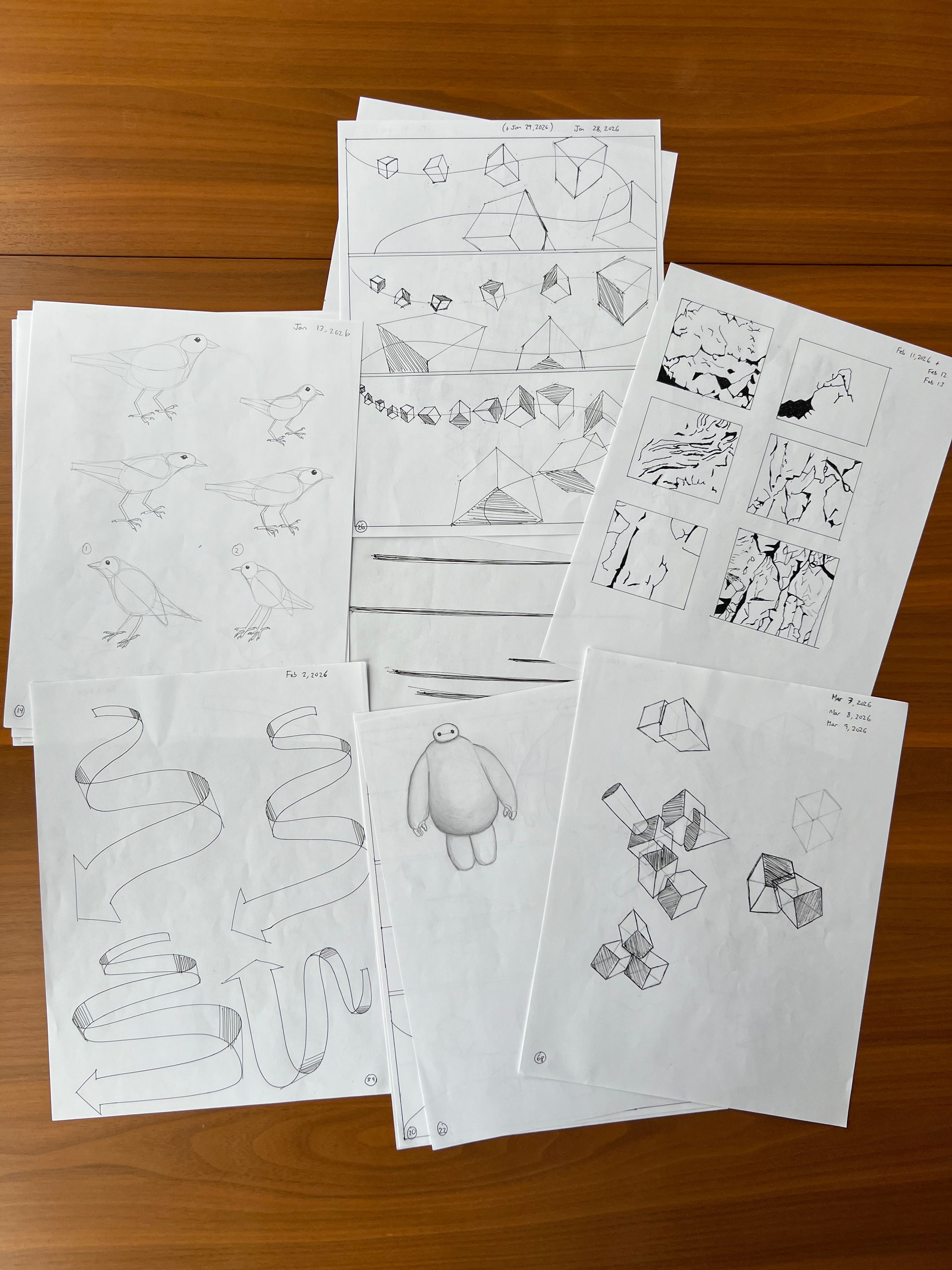
A sample from the first two months. Some box practice, some texture, some birds, some curvature, and some “form intersections” (modeling how shapes intersect with each other in 3d space). Also one Baymax.
I’ve probably drawn a hundred boxes by now…
its interesting to see a new perspective and insights on something i do frequently without much thought. this immediately made me pick up a pen to draw
I WANT PATRICK STAR REVEAL!!!