
For years, I have been bothered by the fact that there are virtually infinitely many books you could read. (One estimate suggests there are more than 150 million books in existence, with about 10-20 million of them being in English.) And somehow, the more you read, the longer your to-read list becomes. This is before we even get to papers and blog posts.
There are two questions one might contemplate when it comes to choosing a book to read:
Here are some books on my bookshelf. Which one do I feel like reading right now?
Out of all 150 million books in existence, which one is the best for me to read?
If you are susceptible to a certain kind of brainworm, you will tend to substitute the second question for the first. And you will take the same approach to life in general: out of all 150 million lives in existence, which one is best for me to lead? But for almost all the decisions one makes in life, this framing of the question is an objectively worse one to be contemplating.
But this framing is irresistible. The Optimizing Mind always asks: MORE! BETTER! BEST! How can I obtain the best? How can I extract the maximal amount of juice out of this life? Give me the OBJECTIVE answer!
This is greedy. We can think of this as the bad kind of greed, the Machiavellian greed for money and power. Or we can think of it as the greed of a child: the relentless, innocent desire for more experience. It is precious that children keep wanting to play, that they keep saying, “Do it again! Do it again!” As such, it is precious to be the kind of person who wants to read all the books, who wants to read the best books, who wants to learn as much as possible in life.
Back to the question: What book to read next? Which among the millions of hypothetical options to take? The problem with “oh my god there are 150 million books, what do I DO about this,” is that it channels a well-intentioned impulse (“I want to experience as much as there is to experience”) but applies the incorrect tool for it (Thinking and Optimizing, rather than Being and Doing).
I wrote earlier that I’ve been enjoying Ruth Ozeki’s The Book of Form and Emptiness. Another hundred pages since my last post (yes, I’m a slow reader), I continue to be mesmerized by it. In this book, the main character Benny hears voices in everything. To Benny, everything has a soul, everything is constantly speaking. As I have been reading it, I feel like I am listening more closely to the objects around me. One of the characters is obsessed with snow globes and now I keep thinking about snow globes.
There was no shortage of snow globes on eBay. They came in every color and theme and price range, and Annabelle was enchanted by the sheer variety. People were so creative to think of making snow globes in the first place, but then to make so many different kinds! She had her other collections, all her vintage toys, books, bottles, and postcards, each one with its own story. She hadn’t meant to start collecting snow globes, too, but the little turtle one she’d bought at the Thrift shop had cheered her so tremendously. It sat at the base of her main Mission Control monitor, and whenever she started feeling overwhelmed by the news, she would pick up the snow globe, turn it upside down, and watch the iridescent sparkles swirl and settle. There was no news inside the globe, and nothing ever changed. There, the world stayed exactly the way it was, and she found this reassuring.
Strange as it sounds, Ozeki’s book seems to be rehabilitating my relationship to Physical Objects in general. This relationship has always been strained: the physical objects around me either feel like a burden (too heavy, takes up space), or something I am overly attached to (and so I am terrified of losing or damaging it). For example, I get very attached to my physical copies of books, and I get bothered by the way their covers get frayed. It feels physically painful every time I look at it.
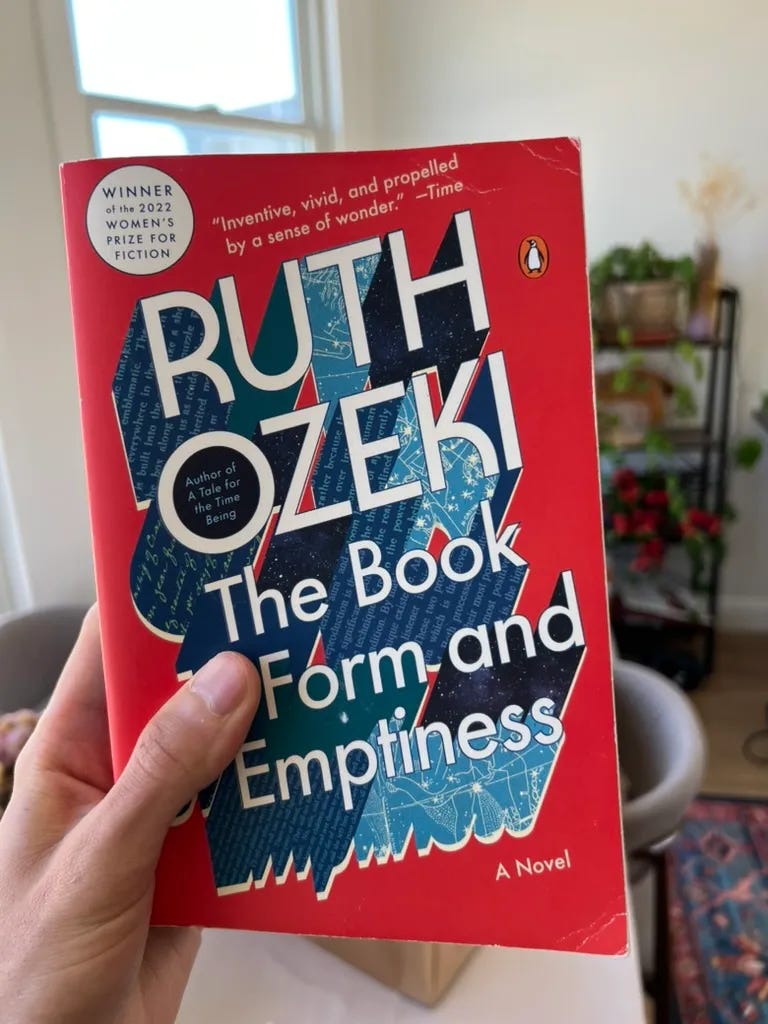
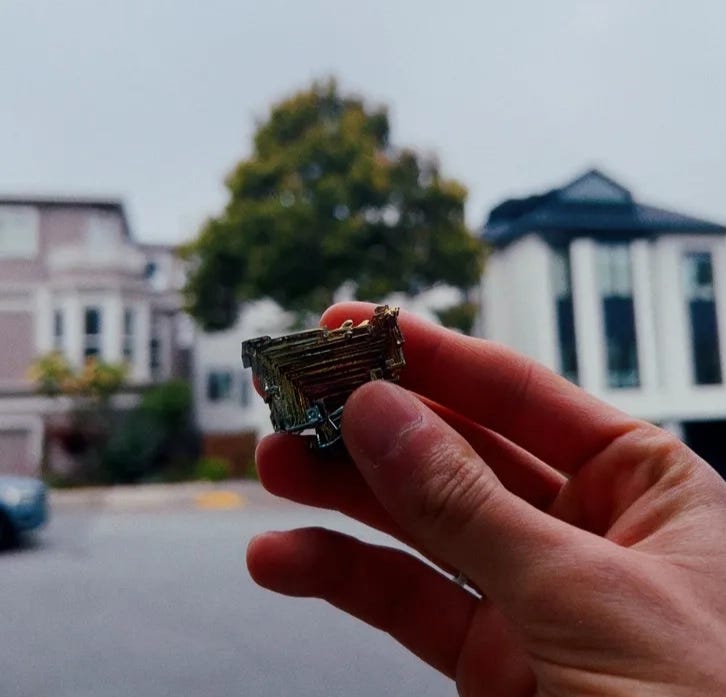
Over the years, this fussiness has toned down, and this seems to be accelerated by Ozeki’s book. She is making me appreciate the beauty of physical objects more while also not getting overly attached to them? I recently obtained a piece of bismuth at a store and I have been telling literally everyone about it. In a way, I treasure it as much as I treasure the book – I have been carrying it around with me most places I go and staring at it most nights. But, in an act of cosmic symbolism, little pieces of it has been chipping off over time, because bismuth is a relatively fragile mineral. When I first noticed this happening, I was devastated for a second, and then I threw the tiny little chips in the air on a hill as a sacrifice to the universe.
I feel a bit of grief saying all of this. Because as much as this is the exact kind of relationship I would like to have to the books I read (and to life in general), I can see the way that my Optimizing Mind begins to ask: OK, and how MORE? How BETTER? MORE transformative books, MORE books I really like, ALL the books, read ALL the books in case they affect you in the same way. Every time I have a sacred experience, my Optimizing Mind tries to figure out what it can do to capitalize on and appropriate that experience. Our culture owes us better than to have taught us this.
Back to the question, again: How to choose the next book? Well, how did I go about “choosing” Ozeki’s book? I didn’t really. I stumbled upon it at a bookstore. To be fair, I had been primed to buy it because I had previously read Ozeki’s other book, A Tale for the Time Being – but that also happened by accident. I got A Tale for the Time Being through one of those book exchanges where all the books are wrapped in paper and you pick one at random. So maybe it is more appropriate to say that Ozeki’s books chose me than I chose them.
I saw a video by Uncle Pappy the other day about the way we are always in a rush to finish things. He says: “You can try to complete a million checkboxes but you will forget all of them, or you can find a stream and spend the day sitting with it, and make a real memory.” I am perpetually burdened by all the books I haven’t read and the books I haven’t finished, but then I remember that this is the exact impulse that takes away from any one book truly moving me.
Thanks to Grant and James for feedback. Cover image by Jeroen Lam.