
I think of being gentle towards people as offering them a pair of training wheels. They are useful at first, when the person is getting their bearings, and eventually they are no longer needed.
Consider: I had a lot of social anxiety when I started tweeting six years ago. Early on, there was this person named Tom I had followed who was a great writer. Tom posted an interesting tweet, and I replied to it with a question. But Tom didn’t reply back for several hours, and I got so anxious about this that I deleted my comment.
A few hours later, to my surprise, Tom DMed me:
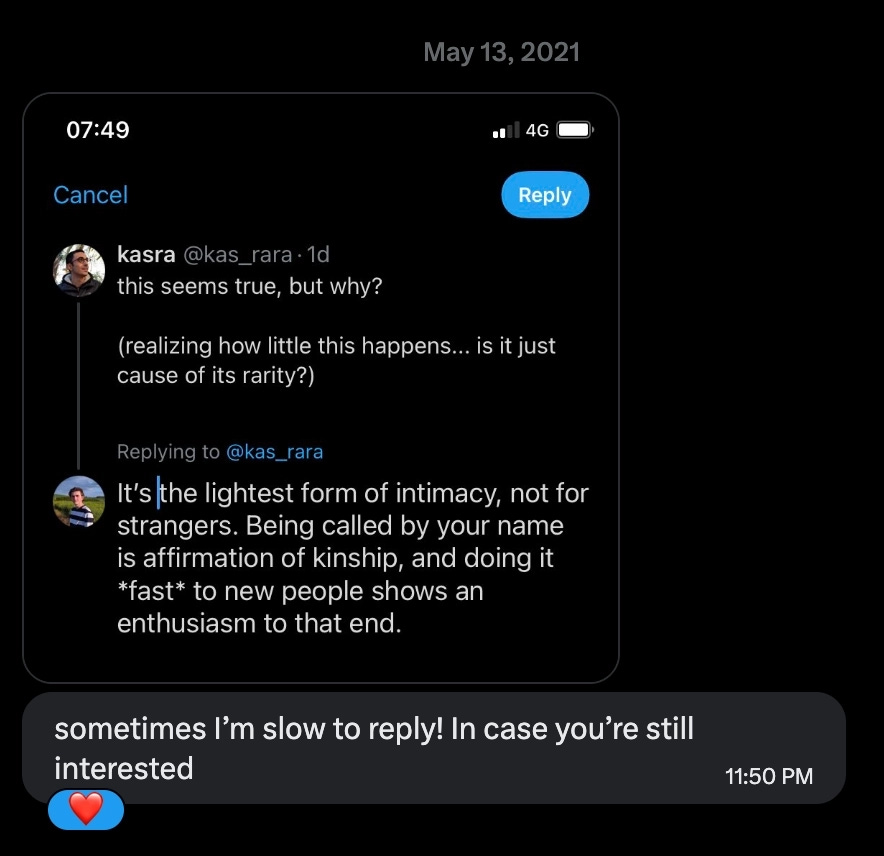
This was then followed by this exchange:
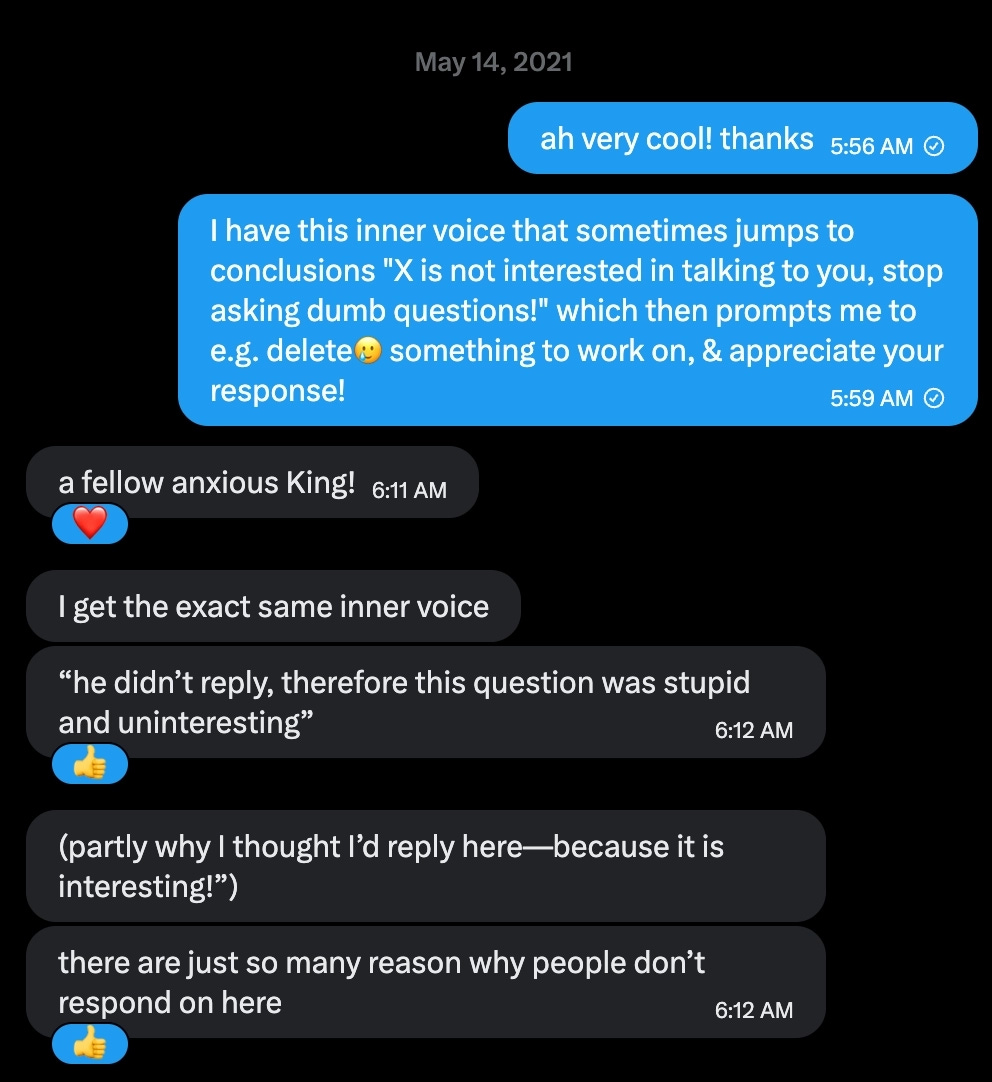
The “anxious King” comment really stuck with me. Tom provided the training wheels for my early exchanges on twitter, by letting me know that it’s normal to be this unsure of yourself when you’re just starting out. If he had never said this (or worse, if he had been actively mean), I might have gotten discouraged enough to give up on the whole tweeting thing altogether.
Five years and six thousand tweets later, I no longer need affirmation when posting a reply. I now reply to people’s tweets all the time and immediately forget that I did so. It shocks me, in fact, to think about how anxious I was in that chat with Tom. But it reminds me also to provide that same gentleness to other people who are just starting out. To supply the training wheels for people who are showing up with more hesitation and self-doubt than most.
Gentleness as virtue vs gentleness as weakness
It strikes me that there are two very different attitudes towards gentleness in our culture, both of which I resonate with.
View #1: Gentleness is a virtue. You have no idea what someone else is going through, and it can make someone’s day to be kind and supportive, to provide a blanket for their anxieties. We are all going through life for the first time. This view is captured nicely by one of my favorite internet memes:
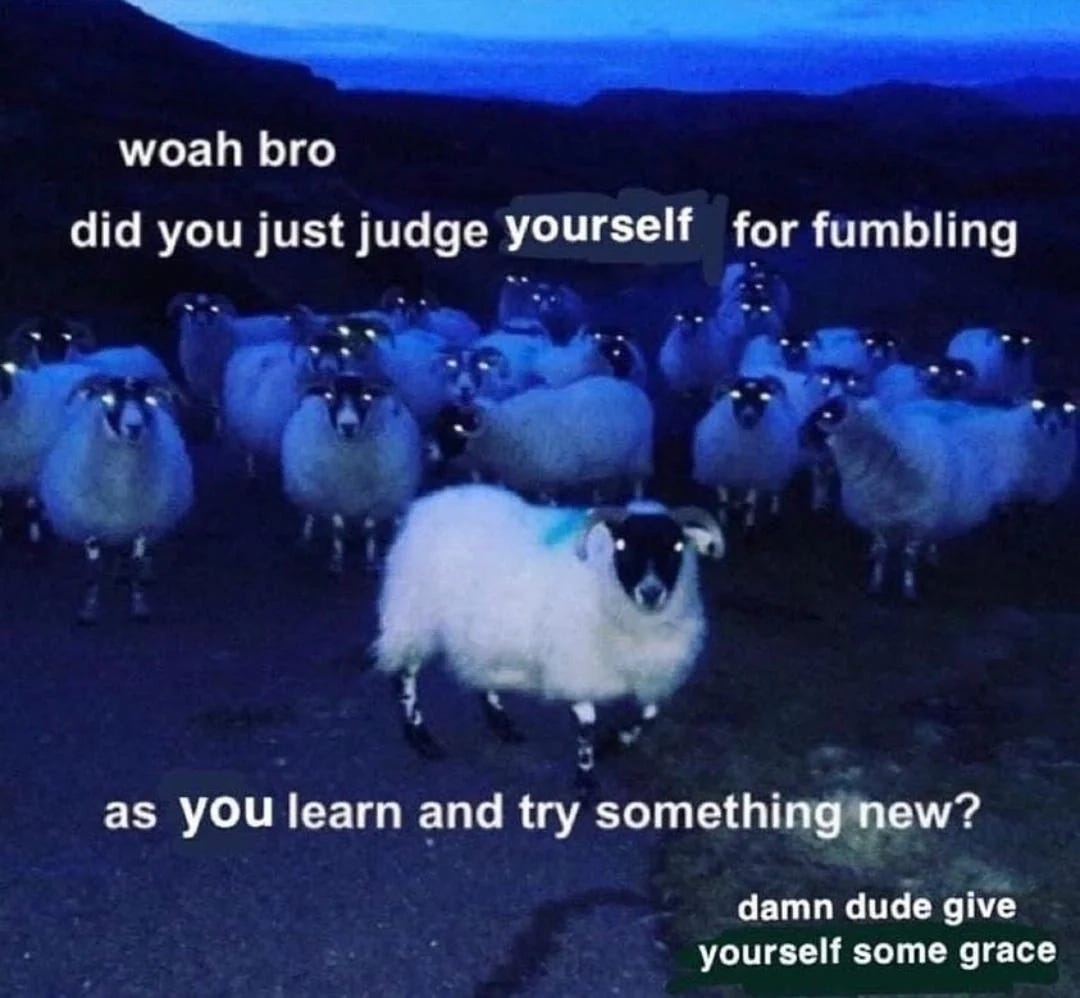
View #2: People are too soft these days. Men used to go to war and you’re here deleting your tweets because no one responded. There is a social cost to all this emphasis on gentleness: everyone begins to feel responsible for taking care of everyone else and we stop respecting each other’s autonomy. The more gentle we are with each other, the more we reinforce this anxious, validation-seeking behavior. As some say, we should kill phrases like “no worries if not” because they make you sound weak.
The story of my life the past several years has been to shift from being firmly in the first camp (gentleness-maxxing) to slowly appreciating the benefits of both views. Thinking of gentleness as analogous to training wheels helps me synthesize the two perspectives. The truth is, different people need different levels of gentleness at different times. We are all working towards having the self-confidence and self-mastery to no longer need the training wheels, but depending on the specific domain and where you are in life, you may be closer or further from that point.
Bids for gentleness are a sign of competence, not weakness
Having spent many years as an anxious person who needed the kind of gentleness I’m talking about, there is something I have come to appreciate about people like me.
If you’re an anxious person, you tend to make “bids for gentleness,” usually unconsciously. Consider the socially anxious person who, when wanting to hang out with someone, says, “I would like to hang out with you but no worries if you’re not interested!!” Or even my own messages to Tom: “thanks for the message! yea I have a problem…I def need to work on it…thanks again.” To the receiver, messages like this may come across as insecure, and some people might even call it weak or annoying. But in my view there is an underappreciated form of competence taking place here.
What the sender of the message is doing here is, consciously or not, communicating their anxiety. They are in effect saying: “I don’t feel totally comfortable saying this but I am going to do it anyway—please be gentle if you have to let me down.” This is (1) courageous (they are doing it scared), and (2) a clear example of communicating your needs, even if it’s done somewhat implicitly.
In effect, the anxious person is sending out a signal that “I need training wheels for this particular kind of interaction.” In doing so, they will filter out people who lack the patience or interest in providing those training wheels, which allows them to find the right people who will meet the needs they have at this particular stage of life.
“Everyone is too nice” is a matter of feedback loops
I agree with the “people are too soft” camp in one sense: it’s possible to overdo the gentleness thing. But this usually has more to do with how people respond to the anxious person than with the anxious person himself.
There is a negative feedback loop that can happen which looks like this:
You don’t feel sure of yourself, so you seek validation from other people;
other people sense this, so they give you validation;
but because everyone else views you this way, you keep thinking that you are someone who needs validation, so you keep seeking more of it;
no one really tests the counterfactual of “what if we were more blunt with each other.”
We are very receptive to other people’s perceptions of us, so unless we are quite sure of our own needs, it’s easy for us to just go along with what other people think we need. If the subculture you are in has a norm like “humans are very fragile so we should all be super gentle with each other,” this feedback loop gets particularly strong. You might be more capable of taking punches than you (and other people) give you credit for.
The key is for everyone to develop the skill of being attuned enough to other people to have a better read on what they actually need. This is hard and takes a lot of time. Some people are naturally better at it than others, but I also think it’s something you get better at when you become more present.
In the right supportive context, gentleness is gradually not needed
When you get confident enough biking you can discard the training wheels. When you have enough reps of exchanging comments on twitter, you no longer need every comment to validate that it’s okay for you to be making comments.
It’s important to recognize, though, that there is no one pace everyone develops at. Our minds are complex and everyone has their own history. While I haven’t “solved” social anxiety, I do feel to be in a better place with it than five years ago – but also, five years is a long time to only get slightly better at social anxiety!
It’s hard to outgrow your anxieties if you’re constantly overwhelmed by them. You need to be “above water” in order to slowly get better, and that requires the right personal mindset and also the right external circumstances. Imagine you’re injured and need a crutch, and you also need to walk twelve miles a day. It’s going to be very hard to heal, although it may eventually happen, very slowly.
Conversely, if you are in a life situation where you can rest a lot, then you will heal much faster. You wouldn’t judge your broken bones for not fixing themselves quickly enough, you just give them the support they need. That is how I think about outgrowing our insecurities.
In the right place and right time, yelling can be supportive
I recently saw a viral video of a college basketball coach aggressively berating one of her players. It turned into an internet meme so you may have already seen it:
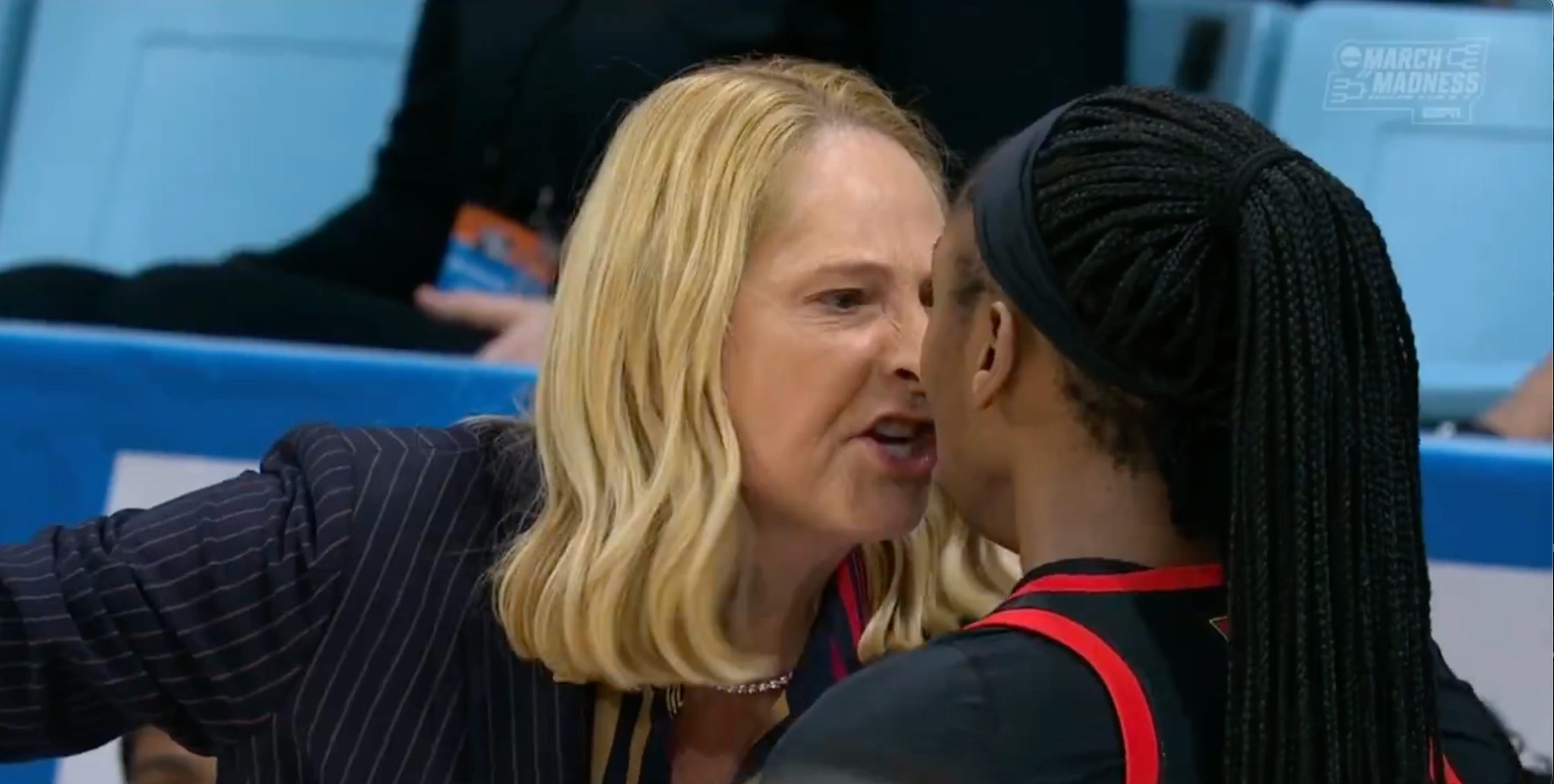
When I first watched it I had this familiar, triggered reaction: this is cruel, unjust, no one should be talked to like this. But there was a very illuminating New York Times article on the interaction which shifted my perspective. It turns out that there is a mutual agreement between the player and coach that this is what’s best for the player. From the player who received the yelling:
“Don’t tell me what I want to hear,” Okananwa, a junior, told Frese during one of their first conversations. “I want to be coached hard. I want to be elite.”
And the player and coach had this exchange after the yelling in the video:
It worked. After the game, Frese sent Okananwa a text: “Sorry for yelling so hard at you. However, I do love being able to coach you hard. I want it all for you.”
Okananwa replied: “Coach, you know I can take and always embrace your hard coaching for me. For the places I want to go, I need it. And thank you for holding me to such a high standard. It’s going to pay off for me in the future.”
To see two people reflecting on such a heated, aggressive exchange as a good thing was surprising to me. Of course, this can only happen after a requisite baseline of trust has already been established between the coach and player. And sometimes the coach can be miscalibrated! From the article:
To reach that point, Frese has tested players in practice to see how they handle yelling. She’s made mistakes and misinterpreted things in the past. If she yelled at a player during a practice but noticed it didn’t sit right with them, she would follow up to explain where she was coming from.
While I’m still not at the level where I can appreciate anyone yelling at me, I am starting to see what it looks like to be able to receive more frank (and even aggressive) support. I recently started working with a coach who, in the very first session we had, interrupted me and said “you’re monologuing with absolutely no affect, like you’re repeating a script. Start over and try again.” While in past years this would have felt hurtful, in the session it was extremely liberating, both because I was self-assured enough to not take it personally, and because I could tell it was coming from a place of authenticity and respect, rather than disdain.
Coda
This is what I think it all boils down to: approaching each person with respect for their autonomy. You can completely respect someone’s autonomy while being very frank with them. You can also completely respect someone’s autonomy while being gentle with them. To be attuned to other people is to be gentle when they need it, and blunt when they can handle it, while respecting and loving them throughout the process.
As much as I have been appreciating bluntness more over the years, I still have an affinity for gentleness because I understand what it’s like to need it, and to feel like the world is not able to offer it to you. As that famous song goes, “lean on me when you’re not strong; for it won’t be long till I need somebody to lean on.” Human existence has the tendency to be terrifying sometimes, whether that’s because you have a predisposition to anxiety or because you’re trying something new or because you are just going through a rough patch. Gentleness is just about holding each other’s hand for a little while as we endure that whole ordeal.
Really enjoyed this! Particularly the example of the basketball coach which I had not seen before.
I'm someone who is often very hard on people I care about, intentionally so. And, there have been times when my approach was wrong and I needed to change it/I did not apply the right level of gentleness given my relationship with the other person. But I think that if I truly care about someone, I should be willing to accept temporary discomfort to help them grow, or learn that I am wrong/misjudging the situation. I like that you've provided a mental model of sorts for calibrating this.
When I can reach a high level of trust with someone, I am grateful to be able to be more intense when I think it can be more helpful to the other person. Once my brother told me that "when you give me a compliment I know you mean it because you won't say something nice to me if you don't believe it, you'll tell me what you actually mean" and I think this embodies the value I see in being less gentle at times. It means that when I am more gentle it is taken with higher value and more authenticity.
this was such a lovely read, thank you sincerely for writing and sharing