
The first step in the story is to experience the bliss of silence. You start with: “wait, why is it so hard to close my eyes and count ten breaths without getting distracted??” You investigate further, and you realize that nothing about your mind was what you thought it was. You are not the chatter in your head, and if you shift your attention in the right ways for long enough while sitting still, you can access a sense of peace you had never experienced before.
I don’t just mean “peace” in the sense of “ah, feels nice to have a long weekend,” or “phew, they didn’t catch me in this round of layoffs.” I mean: everything is perfect and has always been perfect and there is nothing to worry about and I am one with God. I mean a peace that feels expansive, that makes you forgive everyone who’s ever wronged you and not identify with your mistakes or your accomplishments or your future plans. The kind of peace where you can sit and stare at unadorned drywall for twenty minutes and be gobsmacked by its beauty.
When you experience this kind of peace and notice that it is very strongly correlated with long periods of concentrated silence, you think, okay, I need to experience as much silence as possible. Can all you people texting me stfu please. Same with your coworkers, your email newsletters, social media, world events. You just want silence. You want there to not be things in life that you have to react to.
This is especially notable when you go on silent retreat, and you actually do shut out the entire world for ten days. You also don’t talk to anyone, read anything, or look at any screens. It’s just you and your own mind and the trees outside. And lo and behold, even more peace. Can we have this forever?
In theory you could. You could make your whole life a retreat, devote your existence to the practice of silent meditation. And maybe you’ll do that one day, but there are too many things you enjoy about life right now, like your friends, your parents, and good television. But you are stuck in a bind because the monastic life does seem more “pure,” it seems simpler. It’s frustrating to deal with all the disappointments of being a normal human with normal desires.
So you spend a long while being on the fence about this whole situation. You’re living your ordinary life but you somehow feel like you should be living differently. You shut your phone off for days at a time, but you find that turning it back on is always an anxiety-ridden ordeal. You say no to social plans so you can get your days of silence, but then you feel left out. You abstain from social media, which gives you a feeling of clarity, and then that clarity is quickly replaced with seething jealousy when you realize that your friends who didn’t abstain from social media became famous.
You are torn between two worlds and you keep searching for the epiphany that will get you out of this mess. But this time there is no singular epiphany that fixes the problem. It is instead a series of small and uncomfortable steps.
While your first retreat was amazing, the second one isn’t as good. It is somehow harder, and you’re not left with the months-long afterglow of the first one. You realize that the problems in your life continue to be problems, despite your many experiences of transcendence. You think to yourself, maybe those isolated moments of intense unequivocal peace aren’t what life is really all about?
By happenstance, you run into traditions which go about this entire project of human development differently, exemplified by the table below. The traditions you were more familiar with emphasize “saintliness, peace, renunciation”, where pleasure is bad and the ordinary world is corrupt. But there are also traditions that are about “nobility, heroism, mastery, play,” where the ordinary world is sacred and pleasure is good. You realize the space of spiritual paths is much wider than you thought.
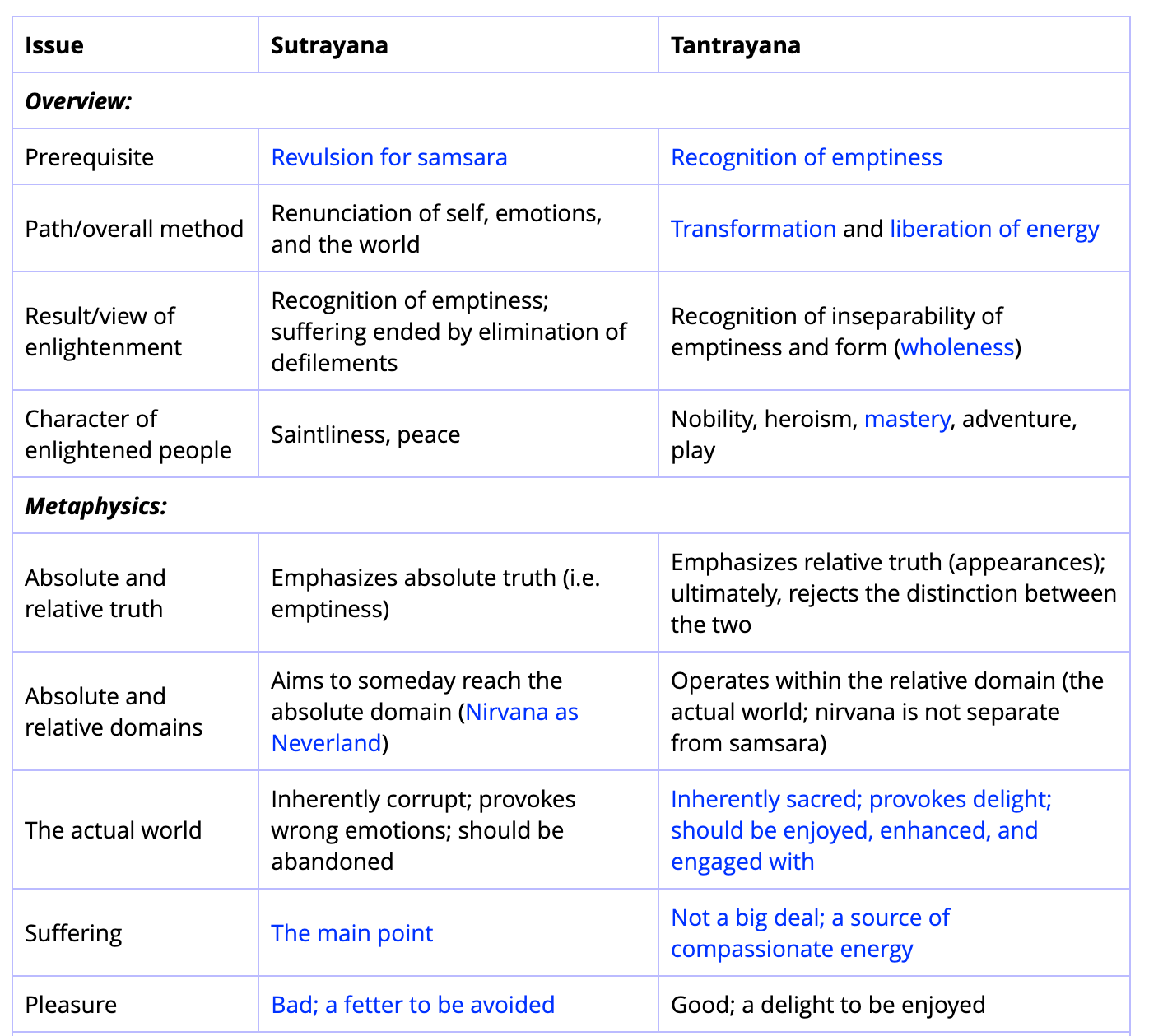
You begin to wonder if you always need the ten days of silence or an entire hour of practice to get the presence that you want. You begin to think that the long periods of practice help, but you can also drop in instantly, because you are sort of already there. Omori Sogen: “It is said that if we sit for one minute we are Buddhas for one minute, and that even in one minute of zazen the whole truth in its completeness is embraced.”1
You begin to wonder if all the things you had shut away, that you believed were “distractions —work, interpersonal conflict, romance, cravings, social anxiety—aren’t themselves part of the practice. That the unpleasant emotions aren’t something to run away from. That there might even be something holy in the experience of being anxious before going to a party. Bruce Tift: “The sensations we flee from, that raw panic beneath our emotional strategies, might actually be the texture of openness itself, filtered through a nervous system that reads groundlessness as threat.”2
All of this feels like a new kind of adulthood. There isn’t one transcendental experience that marks it, of course, because the transcendental experiences are no longer the point. But you notice something has changed when you get home from travel and post online “back in town, hit me up if you wanna write together, meditate, go out dancing, etc”, and a friend you haven’t spoken to in a while responds: “I remember a time in your life when you said you couldn’t go out dancing because the music was too loud for your ears.” And you forgot you had said this. You’ve always been sensitive to the noise, of course, and you still are. But you no longer define yourself in opposition to it.
From Introduction to Zen Training